SIZING: The Single Most Important Factor when Buying Safety Footwear

It’s probably been a very long time since you were a kid, experiencing the years pass you by between age 6 and 18. I recall vividly, the annual (or sometimes bi-annual) anguish my parents visually expressed when I advised them my school shoes no longer fitted my feet. That rapid growth from kiddies size 11 to adult size 5 over the space of just 4 or 5 years goes to shows the remarkable and ever changing foot growth we experience. It’s important to remember that whilst around age 18 things start to become more “stable” and growth does plateau… but, your feet never stop growing. Now when wearing a slipslop, sandal, running shoe, dress shoe or even slippers, all these upper materials can and will stretch and distort. They are flexible and designed to do so. Of course you need to be in the correct “ball-park” size, but even if you are out a little bit, you don’t experience serious discomfort or fatigue. The soles are soft and super flexible, made from super lightweight PVC or EVA. And for example, if you are a Size 8, that will be the first size you ask for when trying on a new pair in store. Often, you may even ask for a Size 7 and Size 9 to accompany the fitting session. You walk around a bit, maybe jump up and down once or twice and even do a little Usain Bolt sprint over a few metres. And once satisfied, you purchase.

In the industrial sector, we have a few things to take into consideration.

  • You, or your company procurement manager may be making a bulk purchase of one style of shoe or boot for an entire workforce. This, simply issued to you based on previous purchase records from the years’ before, or on your stating your size at your new place of work.
  • The upper materials on safety footwear are not fabrics or materials, but thick leather animal hides. They are able to be “broken-in”, and soften over a week or two with the application of polish (nourishment) and exposure to heat (like the sun) and your daily foot movement.
  • We now have an immovable steel toe cap at the front. Which will cover your forefoot and toes. It does not bend, flex or stretch. It will not be broken!

These three factors are the founding principles of why accurate sizing is crucial to comfort, safety and productivity. And why it is so important to ensure you are getting into the correct size safety boot or shoe.

We always stress to our clients, that our footwear is graded and measured to be purchased in UK sizing. Often errors are made when someone buys in US sizing, which is a full size difference out. That will bring a whole world of hurt, confusion and irritation to the purchaser who will argue that the “boot is a problem”, where the entire exercise can simply be resolved with asking if they ordered based on UK or US sizing. And what about continental (EUR) sizing? Size 42 for example, is a UK Size 8.

So it becomes very important to make sure you check your conversion country, and sizing annually. Age, bodyweight and work environment all play a part in foot sizing changing over the years or even during the course of the day. The foot is about 7% larger in the afternoon than when you woke and stood up on the same morning. So we always recommend measuring your feet in the afternoon, as to ensure the boot or shoe will fit best at your largest size during the day. Every extra 5kgs of weight you add to your frame, also applies further pressure onto your feet and makes them larger. In the same way your pants size changes.

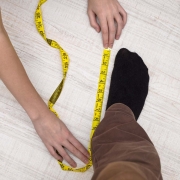
We get calls from clients asking us to please tell them what size they should buy, based on what shoe they normally wear daily (the DWK; dans / werk and kerk). The easiest way to check this measurement is often to stand barefoot, on a blank A4 sheet of paper… corner to corner, and measure from the furthest point of the outer edge of your foot, from the centre of your heel to your big toe. Based on that centimetre reading, you will fall into a sizing chart.

We’ve added this sizing chart for you to review before your purchase.

And one final thing, a nice comfortable, snug fit is exactly what you want. Don’t buy a size up because of the steel toe cap. Toe caps are designed with a bit of “let” in the front. Buy the UK size you normally wear. You don’t want a boot or shoe that is too big (or you will slide around inside), nor too small (as the tightness will end up causing pressure on the nerves around the feet, blisters on the toes, and a burning sensation underneath the feet).

So get it right the first time, be comfortable and stay productive. It is not always the boot’s fault 😊

US SizesEuro SizesUK SizesInchesCM
6395.59.25″23.5
6.53969.5″24.1
7406.59.625″24.4
7.540-4179.75″24.8
8417.59.9375″25.4
8.541-42810.125″25.7
9428.510.25″26
9.542-43910.4375″26.7
10439.510.5625″27
10.543-441010.75″27.3
114410.510.9375″27.9
11.544-451111.125″28.3
124511.511.25″28.6
134612.511.5625″29.4
144713.511.875″30.2
154814.512.1875″31
164915.512.5″31.8

Basic safety boot and shoe care guidelines

Whilst your ProFit safety boots are tough and are built to take a beating whilst your are hard at work there are a few basic things that need to be taken into consideration, there are also a few basic steps you can take to make sure those boots last longer and remain impervious to your busy day on site.

How Do I Look After My Safety Boots & Safety Shoes?

  • Polish your boots regularly, with a commercial available footwear product (like Kiwi or Nugget), including on the day of purchase – before first wear. Do not use synthetic squeegee type bottles with a sponge end.
  • Clean your shoes regularly (use the spun bonded cloth inside the box) to remove excess dirt and grime on the upper.
  • Remove excess mud, dust or dirt with a brush from the sole.
  • Remove any upper marks using a damp cloth or light soapy solution if necessary.
  • Never force dry the footwear (near a fire, heater or with a hair dryer) if it becomes wet, as a direct heat source may distort the upper and cause the leather to crack. (Crumple newspaper into balls and jam them into the shoe/boot to absorb water overnight)
  • Never leave the bio-degradable PU soles in an unventilated or dark environment for long periods (over 24 months) in order to avoid hydrolysis.
  • Always undo the laces of the boot before removing. Do not try and turn it into a slip on. Constant standing on, and pressure applied to the back of the boot may cause the upper to loosen from the sole.
  • Allow the boot to dry “internally” overnight – open the tongue as far forward as possible and remove the top-sock/insole. (Your feet sweat 200ml per day).
  • Never throw “foot powder” into the boot. Foot powder is for the foot and not the boot! Powder inside the boot can become a paste (when mixed with sweat) and will trap air flow, reducing the breathability of the leather – thereby increasing the temperature inside the boot.
  • Where possible try to avoid deliberately scuffing the upper leather, treading on sharp edges that can cut the sole and walking/working in excess water for long periods of time. All of these can start to degrade the overall material of the shoe and cause long last irreparable damage.

Contact the team today to get advice on the perfect safety shoe for your job – info@profitfootwear.co.za or give us a call on +27 11 892 8030

Polyurethane Injected Soles and Hydrolysis

Our soles are made of PU (Polyurethane soles) in order to be anti-slip, anti-static and oil/acid resistant.

Because PU has organic origins, it is biodegradable over time.

In a society where increasing attention is being focused on protecting our fragile environment, many progressive companies are insisting that, as far as possible, consumables such as safety footwear conform to environmentally sound specifications. The process of biodegradation is slow, taking place over many years, ultimately rendering the polyurethane to a number of benign compounds.

However, to ensure the longevity of the footwear it needs to be stored in the correct conditions. If left in an unventilated area for between 12 and 24 months (or longer), the soles will go through a process called Hydrolysis in which the plasticizer (which makes the soles flexible) leaves the sole, and the soles becomes very soft, then brittle, and begin to crack and break into small pieces.

Hydrolysis is a double decomposition reaction, with water as one of the reactants. Simply put, the oxygen atom in water bonds with the carbon atom of the esters in the polyurethane. This carbon – oxygen bond is unstable, and eventually also breaks down, leading to the gradual disintegration of the polyurethane.

Hydrolysis in safety footwear only becomes a serious issue when four factors combine to create the ideal environment:

  • Water
  • Temperature
  • Darkness
  • Time

Therefore, lengthy storage (longer than two years) in a hot and humid climate is potentially the perfect catalyst for hydrolysis.

New polyurethane formulations and the addition of more sophisticated chemicals significantly retard the process of hydrolysis, but following a few simple steps can almost eliminate it entirely:

  • Rotate stock frequently on a first in, first out basis. Do not keep polyurethane soled footwear on the shelf for longer than a year.
  • Be aware of the climate in which the footwear will be worn.
  • Encourage the wearer to properly aerate the footwear after use.
  • Do not wear polyurethane soled footwear where gumboots would be more suitable.

The effects of Hydrolysis cannot be seen as a fault, but simply a characteristic of the compounds used to create the soles.

However, if warn regularly and the shoes are then in fresh air, warmth and sunlight the product will not experience this process. In fact, the shoes should then last for many years. Boots of 4 to 5 years old are quite commonly seen in good condition when maintained and polished regularly.

We have printed the warning regarding Hydrolysis on the fabric insert inside the box, to make end users aware of it.

Contact the team today to get advice on the perfect fitting safety shoe – info@profitfootwear.co.za or give us a call on +27 11 892 8030