
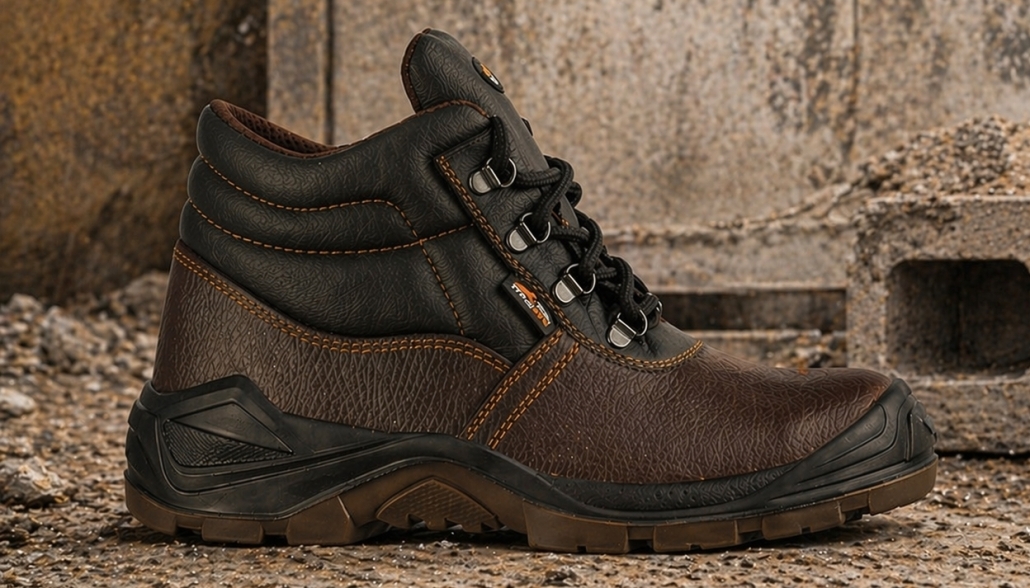
Why Safety Shoes and Boots Can’t Solve Foot Problems
But The PPE Can Still Play a Vital Role
In the world of industrial PPE, few misconceptions are as persistent – and as potentially dangerous – as the belief that safety footwear can “fix” foot problems.
It cannot.
Safety boots and shoes are engineered for protection, not correction. They are governed by stringent international standards such as ISO 20345, which focus on shielding the foot from external hazards – not treating internal biomechanical conditions.
And yet, paradoxically, certain safety footwear designs can significantly assist orthopaedic outcomes when correctly selected.
Understanding this distinction is critical – not just for wearer comfort, but for preventing long-term injury, liability, and costly procurement mistakes.
- The Fundamental Purpose of Safety Footwear
At its core, safety footwear exists for one reason: protection against workplace hazards.
Standards such as ISO 20345 define requirements including:
- 200-joule impact resistance toe caps
- Compression resistance up to 15kN
- Slip resistance, penetration resistance, and material durability
These are mechanical and environmental protections – designed to prevent injury from:
- Falling objects
- Sharp penetrations
- Slips, oils, and chemicals
- Electrical hazards
They are not designed to:
- Correct gait abnormalities
- Treat plantar fasciitis
- Support collapsed arches
- Address diabetic foot conditions
This is the critical divide:
Safety footwear protects the foot. Orthopaedic footwear treats the foot.
- Why Safety Footwear Is Not Orthopaedic Approved
To be considered truly orthopaedic footwear, a shoe must be:
- Individually assessed
- Biomechanically prescribed
- Custom-fitted or medically modified
This is an entirely different regulatory and clinical pathway.
In fact, when safety footwear is modified for orthopaedic use, it becomes a different product category altogether – requiring re-certification and testing to ensure it still meets safety standards.
This creates a major constraint:
Any modification – such as adding custom orthotics or altering the structure – can invalidate the original safety certification unless formally re-tested.
Because of this:
- Most safety footwear is not orthopaedically approved
- Most orthopaedic footwear is not safety certified
Bringing both together is complex, expensive, and highly regulated.
- Why Safety Shoes Cannot Solve Foot Problems
There is a growing tendency – especially in procurement environments – to expect a safety boot to “solve” comfort or medical complaints.
This expectation is fundamentally flawed.
3.1 Foot Problems Are Biomechanical, Not External
Conditions such as:
- Flat feet (overpronation)
- High arches (supination)
- Heel spurs
- Tendonitis
…originate from:
- Skeletal alignment
- Muscle imbalance
- Tendon loading patterns
No off-the-shelf safety boot can realign a person’s biomechanics.
3.2 One Design Cannot Fit Every Foot Type
Safety footwear must comply with standardised shapes and protective structures:
- Fixed toe cap dimensions
- Reinforced midsoles
- Defined upper construction
These limit how much a shoe can adapt to individual anatomy.
3.3 PPE Prioritises Protection Over Adaptability
A safety boot must:
- Hold structural integrity under impact
- Maintain penetration resistance
- Retain certification under stress
This often means:
- Stiffer constructions
- Less flexibility in the sole unit
- Reduced custom shaping capability
In simple terms:
The more protective the boot, the less inherently adaptable it becomes.
- The Hidden Risk of Misusing Safety Footwear
When safety footwear is expected to solve orthopaedic issues, three problems emerge:
4.1 Delayed Medical Treatment
Workers may ignore real conditions, assuming the “right boot” will fix it.
4.2 Incorrect Procurement Decisions
Buyers may over-specify features (e.g., heavy midsoles or rigid structures) that actually worsen discomfort.
4.3 Increased Injury Risk
Poorly matched footwear can lead to:
- Fatigue
- Joint strain
- Reduced stability
Ironically, footwear designed to prevent injury can contribute to it—if misunderstood.
- Where Safety FootwearDoesSupport Orthopaedic Needs
While safety footwear cannot cure foot problems, certain design features make it significantly more compatible with orthopaedic treatment.
This is where intelligent product design becomes critical.
5.1 Removable Innersoles
This is arguably the single most important feature.
Why it matters:
- Allows replacement with custom orthotics
- Maintains correct volume inside the boot
- Enables podiatrists to prescribe inserts without altering the boot structure
Without removable insoles, orthotic intervention becomes almost impossible without compromising fit.
5.2 Wide Toe Caps
Safety boot Toe cap design is often overlooked – but crucial.
A wider, anatomically shaped toe cap:
- Reduces pressure on forefoot deformities
- Accommodates bunions and swelling
- Prevents compression-related nerve issues
Given that toe caps must still meet impact standards, achieving both protection and anatomical space is a significant engineering advantage.
5.3 Reinforced Insole Boards (Stability Platforms)
A high-quality insole board:
- Provides a stable base for orthotics
- Prevents collapse under load
- Maintains consistent support across the foot
This is particularly important for:
- Arch support systems
- Heel stabilisation
- Load distribution
Without a stable platform, even the best orthotic insert loses effectiveness.
- The Balance: Protection vs Comfort vs Adaptability
The most successful safety footwear does not attempt to be orthopaedic.
Instead, it achieves something more practical:
It creates a platform that allows orthopaedic solutions to work effectively – without compromising safety certification.
This is the sweet spot.
And it is where certain manufacturers differentiate themselves.
- Why ProFit Safety Footwear Meets This Need
Within the South African market, ProFit Safety Footwear has positioned itself strongly in this exact space – engineering footwear that bridges the gap between compliance and wearability.
7.1 Designed for Compliance First
All footwear aligns with ISO/SANS requirements and NRCS approval processes, ensuring:
- Certified toe protection
- Tested materials
- Legal compliance for industrial use
This establishes the non-negotiable foundation: safety.
7.2 Built for Real-World Wear
Where ProFit distinguishes itself is in understanding that workers do not stand still – they:
- Walk long distances
- Climb, kneel, and carry loads
- Spend 8-12 hours on their feet
Design features such as:
- Removable insoles
- Carefully considered last shapes
- Balanced sole constructions
…allow the footwear to perform in real-world conditions, not just laboratory tests.
7.3 Orthopaedic Compatibility by Design
Rather than claiming to be orthopaedic, ProFit footwear:
- Accommodates custom orthotics
- Provides sufficient internal volume
- Maintains structural integrity with inserts
This is a crucial distinction:
- Not orthopaedic footwear
- But orthopaedic-compatible safety footwear
7.4 Wide and Practical Toe Cap Design
In many ProFit styles, toe cap geometry is engineered to:
- Maintain required clearance under compression
- Avoid unnecessary lateral pressure
- Improve long-term comfort
This reduces:
- Forefoot fatigue
- Toe crowding
- Circulatory restriction
All while still meeting impact requirements.
7.5 Reinforced Construction for Support
A strong insole board and durable construction:
- Stabilises the foot
- Supports orthotic use
- Prevents premature breakdown
This is particularly important in industries such as:
- Construction
- Engineering
- Mining
Where both load and duration are extreme.
- The Procurement Reality: Choosing the Right Footwear
The key takeaway for safety managers and buyers is simple:
Do not ask safety footwear to solve medical problems.
Instead, ask:
- Can this boot accommodate orthotics?
- Does it provide sufficient toe space?
- Is the platform stable enough for long-term wear?
- Is it correctly specified for the environment?
Over-specifying (e.g., unnecessary steel midsoles or rigid features) can be just as harmful as under-specifying.
- Conclusion: The Right Expectation Leads to the Right Outcome
Safety footwear is one of the most important pieces of PPE – but it is also one of the most misunderstood.
It is not:
- A medical device
- A corrective tool
- A cure for foot conditions
It is:
- A protective system
- A compliance requirement
- A foundation for safe movement in hazardous environments
The real opportunity lies not in trying to turn safety footwear into orthopaedic footwear – but in selecting products that work alongside orthopaedic interventions.
That is where modern, intelligently designed footwear – such as that offered by ProFit Safety Footwear – delivers real value:
Not by claiming to fix the foot,
But by ensuring nothing stands in the way of fixing it properly
Talk to our team now to discuss your safety footwear needs – and we can find you the perfect safety boot for the your job! Call us on +27 11 892 8030 / 8031 / 8032 or drop an email to organise a call info@profitfootwear.co.za

