Why The Specification Sheet Is The Most Important Tool When Comparing Safety Footwear
Two safety boots may look almost identical. They may even carry the same safety classification. But does that mean they offer the same protection, construction, comfort, durability or value for money? Absolutely not.
In the safety footwear industry, one of the most common mistakes made by buyers is comparing products from different manufacturers based almost entirely on appearance (look) and then price.
A black Chelsea safety boot is compared with another black Chelsea safety boot. A lace-up safety shoe is compared with another lace-up safety shoe. Both look remarkably similar, both have protective toe caps, and both are marketed as safety footwear.
The assumption is that they must be equivalent products. They look similar.
Unfortunately, this is where comparisons can become misleading.
At ProFit Safety Footwear, we believe that the only meaningful way to compare safety footwear from different manufacturers is to examine their respective technical specification sheets.
Why? Because when you’re comparing products, you need to compare apples with apples, not apples with oranges.
And in an industry where the products we manufacture and distribute are designed to protect people in potentially hazardous working environments, understanding the differences is considerably more important than simply finding the lowest price.
1. TWO BOOTS. SIMILAR APPEARANCE. VERY DIFFERENT PRODUCTS.
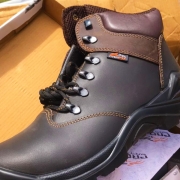
Imagine two safety boots sitting alongside one another.
Both are black. Both have leather uppers. Both have steel toe caps. Both have polyurethane soles. Both carry an appropriate safety footwear certification.
One retails for R350. The other retails for R650.
On appearance alone, the R350 boot seems the obvious choice.
But what happens when we examine the specification sheets?
We might discover that one boot features a single-density polyurethane outsole while the other incorporates a dual-density construction.
One might feature a steel penetration-resistant insert, while the other has no penetration-resistant protection at all.
One might use a full grain leather with a different thickness or finish, and the other is merely a split leather.
One might incorporate additional reinforcement, improved internal cushioning or a different outsole design.
The two products may look remarkably similar, but their technical specifications reveal that they are not necessarily designed to deliver the same performance.
The cheaper boot is not automatically inferior. Equally, the more expensive boot is not automatically superior.
The important question is whether the two products offer comparable specifications, appropriate protection and suitable performance for the intended working environment.
Only once those factors have been established does a meaningful price comparison become possible.
2. THE SPECIFICATION SHEET: YOUR PRODUCT’S TECHNICAL FINGERPRINT
A properly prepared safety footwear specification sheet is far more than a marketing document.
It is a technical description of the product’s construction, materials, protective features and tested performance characteristics.
Depending on the manufacturer and product, it should provide information covering:
- Safety classification: The applicable standard, classification and protective properties.
- Toe cap construction: Whether the protective toe cap is steel, composite or another compliant material. And the shape, design and width!
- Upper material: Leather type, thickness, finish or alternative materials.
- Sole construction: Single-density or dual-density polyurethane, rubber, or other materials.
- Penetration resistance: Whether protection is incorporated (steel or anti puncture material like Kevlar) and the relevant tested classification.
- Slip resistance: The applicable slip-resistance requirements and any additional test markings.
- Electrical properties: Antistatic, conductive or electrically insulating characteristics, where applicable.
- Water protection: Water resistance or repellency claims supported by the relevant tests.
- Additional protection: Metatarsal protection, heat resistance or other specialist features.
- Comfort construction: Footbeds, lining materials, padding and other design features.
Not every safety boot needs every feature listed above.
A warehouse employee, for example, may have very different footwear requirements from someone working in a heavy engineering plant, construction environment or industrial foundry.
The purpose of the specification sheet is not to identify the boot with the longest list of features.
It is to establish whether the product has the correct features for the work it is expected to perform.
That distinction is fundamental.
3. UNDERSTANDING SAFETY CLASSIFICATIONS
Safety classifications provide a valuable starting point when comparing footwear.
International safety footwear requirements are covered by standards such as EN ISO 20345, with different editions and national adoptions applying in different markets.
Under the 2023 edition of EN ISO 20345, classifications include SB, S1, S2, S3 and additional classifications.
These classifications identify combinations of protective properties and performance requirements.
However, buyers need to pay particular attention to the edition of the standard against which the footwear has been tested.
For example, the terminology and requirements relating to penetration resistance, slip resistance and certain other protective characteristics have evolved between editions.
This means two products carrying apparently similar marketing descriptions may not have been assessed against identical requirements.
A buyer should therefore establish:
- Which safety standard and edition applies?
- What safety classification has been awarded?
- Which additional protective markings are present?
- Are the relevant test reports and certification documents available?
- Does the product satisfy the requirements of the intended workplace?
A safety classification is an important benchmark.
But it is not a complete description of the footwear’s materials, construction, comfort or expected service life.
4. MATERIALS MATTER MORE THAN MOST PEOPLE REALISE
Consider leather.
Two manufacturers may describe their products as featuring genuine leather uppers.
Technically, both descriptions may be correct. But leather is not a single, uniform material.
Differences in hide selection, thickness, tanning, finishing, flexibility and water resistance can influence how footwear performs under different working conditions.
The same applies to sole materials. Polyurethane, for example, is widely used in safety footwear because it can offer a useful combination of cushioning, flexibility, abrasion resistance and relatively low weight.
However, polyurethane formulations and sole constructions vary. A single-density polyurethane sole and a dual-density polyurethane sole may offer different characteristics depending on their formulation, hardness, tread geometry and intended application. Importantly, dual-density construction is not automatically superior in every working environment.
Likewise, rubber outsoles may offer useful properties for particular applications, but their suitability depends on the actual compound, construction and tested performance.
The point is simple.
A material description tells you what something is made from. A technical specification helps explain how that material is intended to perform.
That is a very significant difference.
5. STEEL, COMPOSITE AND PENETRATION RESISTANCE: KNOW WHAT YOU ARE BUYING
Protective toe caps are another area where assumptions frequently lead to unfair comparisons.
Some buyers automatically assume that composite toe caps are superior to steel because they are often associated with lighter footwear.
Others assume steel must be stronger simply because it is steel. Neither assumption is sufficient.
Certified toe caps must meet the applicable performance requirements of the relevant safety standard, regardless of their material.
Their suitability depends on factors including construction, fit, weight, thermal properties and the working environment.
The same principle applies to penetration-resistant inserts.
Steel and non-metallic penetration-resistant components are not necessarily interchangeable, and the applicable test methods and classifications must be understood.
For instance, the more recent EN ISO 20345 classifications distinguish between different types of penetration-resistant protection.
A buyer comparing two boots should therefore ask whether both products offer penetration resistance and, if so, what classification and test requirements apply.
Without that information, the comparison may be fundamentally flawed.
6. COMFORT IS IMPORTANT, BUT IT MUST BE EVALUATED PROPERLY
Safety footwear is worn for long periods, often across demanding working environments.
Comfort is therefore a major purchasing consideration. However, comfort is also one of the most subjective characteristics of footwear.
A boot that feels exceptionally comfortable to one employee may not provide the same experience to another. Foot shape, sizing, fit, working surfaces, movement patterns and individual preferences all play a role.
Specification sheets can help buyers identify construction features that may contribute to comfort, including removable footbeds, padded collars, lining materials, sole flexibility and cushioning systems.
But a specification sheet cannot replace a proper fitting or a practical wear trial.
When purchasing footwear for large numbers of employees, it is often sensible to assess both the technical specifications and feedback from representative users.
The best safety boot is not necessarily the one with the softest footbed or the thickest padding. It is the one that combines appropriate protection, correct fit and suitability for the working environment.
7. THE PRICE TRAP: CHEAPER DOES NOT ALWAYS MEAN BETTER VALUE
Price is important.
At ProFit Safety Footwear, we understand that businesses operate within budgets and that procurement managers are under constant pressure to control expenditure.
But there is a difference between purchasing at the lowest price and obtaining the best value.
Consider two hypothetical products.
| Specification | Boot A | Boot B |
|---|---|---|
| Purchase price | R350 | R650 |
| Protective toe cap | Steel | Steel (Extra Wide Fitting) |
| Upper | Leather | Full Grain Leather |
| Sole | Single-density PU | Dual-density PU |
| Penetration-resistant insert | Not included | Included |
| Additional comfort features | Basic footbed | Removable cushioned footbed |
| Intended application | General light-duty work | Work requiring additional specified protection |
Illustrative example only. Actual product suitability depends on the applicable safety classification, verified specifications and workplace risk assessment.
The R350 boot may represent excellent value for an employee whose working environment does not require penetration resistance.
The R650 boot may be more appropriate for an employee whose workplace risk assessment identifies a penetration hazard.
It would be unreasonable to declare either product the better purchase without understanding the application.
Furthermore, the purchase price is only one component of the overall cost.
Replacement frequency, employee acceptance, product performance, supplier reliability and after-sales support can all influence the total cost of ownership.
A more expensive boot that provides a longer useful service life under comparable conditions may ultimately offer better value.
But equally, purchasing expensive features that an employee does not require can represent unnecessary expenditure.
Good procurement is not about buying the cheapest product or the most expensive product. It is about buying the right product at the right price.
8. THE DANGER OF OVER-SPECIFYING AND UNDER-SPECIFYING
One of the most important responsibilities of any occupational health and safety professional is ensuring that personal protective equipment is appropriate for the hazards identified in the workplace.
This includes footwear.
Under-specifying safety footwear can expose employees to hazards against which their footwear does not provide the required protection.
Over-specifying can create unnecessary expenditure and may introduce characteristics that are unsuitable for the application.
For example, a footwear specification developed for a heavy industrial environment may include protective features that are unnecessary for a relatively low-risk indoor workplace.
Conversely, a lightweight safety shoe selected primarily for comfort and appearance may lack protection required for a more demanding application.
Neither approach represents sound purchasing practice.
The correct starting point should always be the workplace risk assessment.
Once the necessary protective requirements have been identified, buyers can shortlist products that meet those requirements.
Only then should competing products be compared on their construction, comfort, service, availability and price.
This is where technical specification sheets become invaluable.
They allow buyers to move beyond subjective opinions and evaluate products against a consistent set of criteria.
9. WHAT ABOUT TWO BOOTS WITH IDENTICAL SPECIFICATIONS?
This is where the comparison becomes particularly interesting.
Suppose two safety boots from competing manufacturers carry the same safety classification.
Both use comparable upper materials, the same general outsole construction, similar protective components and equivalent additional safety features.
Their specification sheets suggest that they are technically comparable.
Now the buyer can begin evaluating the other factors that distinguish the products.
These might include the quality and consistency of manufacturing, fit, actual performance in workplace trials, stock availability, size range, delivery reliability, after-sales service and the supplier’s ability to resolve problems. How about a 1 year manufacturing warranty?! Huge consideration.
A technical specification sheet is therefore not the final answer to every purchasing question.
Rather, it provides the foundation for a fair comparison. Where technical requirements are genuinely equivalent, price becomes a much more meaningful differentiator.
And where one supplier offers more competitive pricing, reliable stockholding and dependable service, the commercial advantage becomes considerably clearer.
10. OUR PHILOSOPHY AT PROFIT SAFETY FOOTWEAR
At ProFit Safety Footwear, we have always believed that customers should understand precisely what they are purchasing.
We do not believe that a product should be considered superior simply because it carries a particular brand name or a higher price tag.
Nor do we believe that a cheaper product should automatically be dismissed as inferior.
We encourage procurement managers, safety officers, distributors and end users to examine the technical specifications of the products they are considering.
Compare the safety classifications.
Compare the materials.
Compare the construction.
Compare the protective components.
Compare the intended applications.
And once those comparisons have established that the products are genuinely equivalent, compare the prices and the after sales service offered by the respective suppliers.
We are confident in the value that ProFit Safety Footwear offers across our product range.
But we also recognise that no single footwear style is suitable for every employee, every industry or every working environment.
That is precisely why we offer different styles, constructions and protective features to meet different requirements.
Our objective is not simply to sell a pair of safety boots.
It is to help our customers make informed purchasing decisions that balance protection, practicality, comfort and value.
Because ultimately, that is what responsible safety footwear procurement should be about.
THE BOTTOM LINE: COMPARE THE PRODUCT, NOT JUST THE PRICE TAG
The next time you are presented with two safety boots from competing brands and asked which represents better value, resist the temptation to make an immediate judgement based on appearance, brand recognition or price.
Request the technical specification sheets.
Read them carefully.
Establish whether the products meet the same applicable safety requirements.
Identify any meaningful differences in their materials, construction and protective properties.
Consider the intended working environment and the needs of the employees who will be wearing them.
And only then make your purchasing decision.
Because two boots that look the same are not necessarily built the same. Two boots that carry the same safety classification are not necessarily identical. And two boots that cost the same do not necessarily deliver the same value.
At ProFit Safety Footwear, we welcome informed comparisons.
In fact, we encourage them.
Compare apples with apples. Compare specifications with specifications. And let the facts, not the price tag alone, guide your decision.
ProFit Safety Footwear
Always Giving You More.